Affichage des articles dont le libellé est chan. Afficher tous les articles

lundi 20 janvier 2025

Surangama Sutra


The Surangama Sutra is one of the major texts of Mahayana Buddhism.

According to tradition, it was translated in 705 from Sanskrit to Chinese. The original Sanskrit version has been lost.

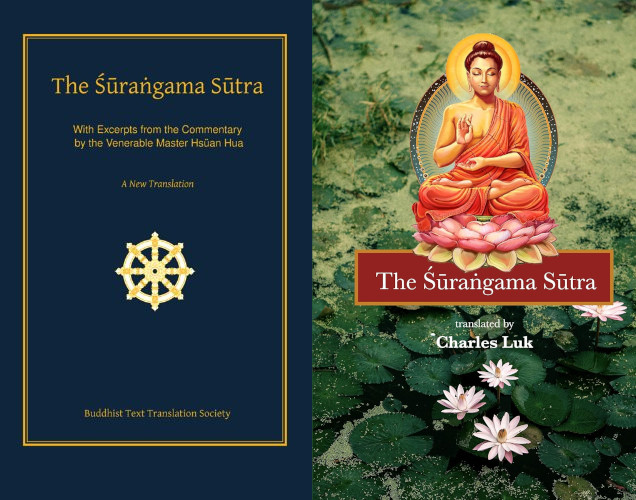
It gradually became the object of particular interest for the masters of the Chan school, including Hsuan Hua 宣化 (1918-1995) and Charles Luk (1898-1978) who contributed greatly to its dissemination and understanding.


The salient points of the Sutra are:

The worthlessness of the (intellectual) study of the Dharma without the practice of Meditation and the respect of moral precepts.

The importance of not falling victim of delusion and demonic influence that may arise during meditation, and of fake self appointed masters and gurus


2 Translations side by side

I have put side by side two translations by Hsuan Hua 宣化 (1918-1995) and Charles Luk (1898-1978) into English of this sutra.

You can download them by clicking on the link:


dimanche 15 novembre 2015

The Monk and the Samurai

samedi 10 mai 2014

Nothing Lacking, Nothing in Excess


The Shin Jin Mei  (Chinese  信心銘  - Xin Xin Ming or Hsin Hsin Ming), Faith in mind, is a poem attributed to the Third Chinese Chan (Zen) Patriarch Kanchi Sozan (Chinese Jianzhi Sengcan  or Chien-chih Seng-ts'an)

One of the earliest Zen document we have, it is a beautiful and syncretic text, in which Indian Mahayana Buddhism is already deeply influenced by Chinese Taoism.

Multiple translations are available, but one of its stanza has been rendered as :

The Way is perfect like Vast Space, with nothing lacking, and nothing in Excess.

Here is a video of Masayaki Shimabukuro Hanshi, which I believe perfectly illustrate Nothing Lacking, Nothing in Excess...


Enjoy, Be inspired, Practice...

mardi 13 août 2013

Samadhi in Action


Samadhi can be achieved through various means : Meditation - Dhyana in Sanskrit, Chan in Chines, Zen in Japanese, Son in Korean - is one of them.

Samadhi can also be achieved through action. Asian disciplines such as Budo (all martial Arts); Shodo - the art of Calligraphy; Chado - the Art of Serving Tea... are ways to achieve Samadhi through action.

The term DO (at the end of Budo, Judo, Shodo, ... etc actually means "Way". Budo is the Way of Martial Arts, Shodo the way of the Brush, Kyudo the way of the bow... This means that these disciplines : Martial Arts, Calligraphy, Archery are used as a way to realize Samadhi.


These ways were not developed exclusively by Asian cultures.Individuals and groups in the Christian and Muslim words have practised various ways to reach Samadhi. And it is also very probable that other cultures also developed them. However Asian people and among them the Japanese more particularly, have developed them in a more particular and systematic way than other cultures have.

This video of Mioko Shida is a perfect example of a non traditional Samadhi at work...


Enjoy.


jeudi 8 août 2013

Bodhidharma's "Outline of Practice"


For various reasons, I have a personal affection for Bodhidharma: he left his country to come teach in another one, and he founded Shaolin Kung Fu and designed the Chi Gong Yi Jin Jing and Xi Sui Jing exercises.

We know little things about him. He is very much a legendary figure. But aren't legends and myth often based on reality (Which reality ?). 


Let us say that sometimes around 475 AD, an Indian Buddhist Master came from India to China to teach the Dhyana school of Buddhism. 

Bodhidharma left us a few short texts  - they are likely transcriptions of his teachings as it is doubtful that he could write Chinese. Today I would like to share with you the most known of these texts, entitled "Outline of Practice" 

It is the text of a translation by Red Pine. If you are interested in the other texts, I suggest you purchase the book The Zen teachings of Bodhidharma

 
Outline of Practice

‘Many roads lead to the Way, but basically there are only two: reason and practice. 

To enter by reason means to realize the essence through instruction and to believe all living things share the same true nature, which isn’t apparent because it’s shrouded by sensation and delusion. Those who turn from delusion back to reality, who meditate on walls, the absence of self and other, the oneness of mortal and sage, and who remain unmoved even by sutras are completely in accord and unspoken agreement with reason. Without moving, without effort, they enter, we say, by reason’.


To enter by practise refers to four all-inclusive practices: suffering injustice, adapting to conditions, seeking nothing, and practising the Dharma.’


‘First, suffering injustice. When those who search for a path encounter adversity, they should think to themselves ‘In countless ages gone by I’ve turned from the essential to the trivial and wandered through all manner of existences, often angry without cause and guilty of numberless transgressions. Now, though I do no wrong, I’m punished by my past. Neither gods nor men can foresee when an evil deed will bear it’s fruit. I accept it with an open heart and without complaint of injustice’. The sutra says ‘When you meet with adversity don’t be upset, because it makes sense’. With such understanding you’re in harmony with reason. And by suffering injustice you enter the path.’


‘Second, adapting to conditions. As mortals we’re ruled by conditions not by ourselves. All the suffering and joy we experience depend on conditions. If we should be blessed by some great reward, such as fame or fortune, it’s the fruit of a seed planted by us in the past. When conditions change, it ends. Why delight in its existence? But while success and failure depend on conditions, the mind neither waxes nor wanes. Those who remain unmoved by the wind of joy silently follow the path.’


‘Third, seeking nothing. People of this world are deluded. They’re always longing for something - always, in a word, seeking. But the wise wake up. They choose reason over custom. They fix their minds on the sublime and let their bodies change with the seasons. All phenomena are empty. They contain nothing worth desiring. ‘Calamity forever alternates with Prosperity’. To dwell in the three realms is to dwell in a burning house. To have a body is to suffer. Does anyone with a body know peace? Those who understand this detach themselves from all that exists and stop imaging or seeking anything. The sutra says ‘To seek is to suffer. To seek nothing is bliss’. When you seek nothing, you’re on the path.’


‘Fourth, practising the Dharma. The Dharma is the truth that all natures are pure. By this truth, all appearances are empty. Defilement and attachment, subject and object don’t exist. The sutra says ‘ The Dharma includes no being because it’s free from the impurity of being, and the Dharma includes no self because it’s free from the impurity of self’. Those wise enough to believe and understand these truth are bound to practise according to the Dharma. And since that which is real includes nothing that is worth begrudging, they give their body, life, and property in charity, without regret, without the vanity of the giver, gift, or recipient, and without bias or attachment. And to eliminate impurity they teach others, but without being attached to form. Thus, through their own practise they’re able to help others and glorify the Way of Enlightenment. And as with charity, they also practise the other virtues to eliminate delusion, they practise nothing at all. This is what’s meant by practising the Dharma.’


Please read and consider carefully. And if you don't agree try to figure out why some guy travelled thousands of miles from India to China 1500 years ago to teach this.
With the help of other masters, we will later try to get more insight in this important text.

samedi 15 septembre 2012

The Last Words of Huineng


As I was sharing with Elliston Roshi my sorrow at the passing of Shimabukuro Hanshi, he suggested I checked what Hui Neng had to say about his own passing, about 1200 years ago. I happened to be reading in Heinrich Dumoulin's “Zen Buddhism, a history – India and China.“ the part about Hui Neng, the 6th Patriarch of Chan (Zen) Buddhism, who was an extremely influential figure of the development of Buddhist Zen in China. 

As he knew his death was coming, Hui Neng addressed his disciples in this way :

" Good bye, all of you. I shall depart from you now. After I am gone, do not weep worldly tears, nor accept condolences, money, and silks from people, do not wear mourning garments, If you did so, it would not accord with the sacred Dharma, nor would you be true disciples of mine. Be the same as you would if I were here. And sit all together in meditation. If you are only peacefully calm and quiet, without motion, without stillness, without birth, without destruction, without coming, without going - this then is the great Way. After I have gone, just practice according to the Dharma in the same way that you did on the days that I was with you. Even though I were still to be in this world, if you went against the teachings, there would be no use in my having stayed here. "


The Cherry Blossom is to flowers, 
what the Samurai is to men.


mardi 10 avril 2012

Modern Taoist and Zen Practices


When Buddhism arrived in China, Taoism had been established there for a long time, with a tradition of spiritual practices somehow similar to the yogic meditative practices of India. The similarities between the 2 great traditions helped the spread of Buddhism in China. It was also the reason why Taoism greatly influenced the practices of Buddhism in general, and of Chan (that branch of Buddhism mostly interested in sitting meditation) in particular.


A clear example of this influence is to be found in the healing techniques  (So Cream method) described by 17th century Japanese Zen Master Hakuin in his Yasenkana. What Hakuin used to heal himself from what he called « Meditation disease » are classical Qi Gong techniques.


Unfortunately the influence of Taoism in Japanese Zen slowly decreased. There might be several reasons for this.


  • Taoism was usually not interested in being spread to the general population, so its higher teachings are usually recorded in very esoteric language that only initiates can understand.
  • Although there are clearly very valuable practices in Taoism, there are also lots of magical and superstitious practices detrimental to Meditation practices.
  • It may not have been easy to find qualified teachers.


This is unfortunate for us, who mostly have learned Zen through the Japanese influence, for some techniques developed by Taoists are very valuable to Zen practice.

Techniques that request the total participation of our bodies to harness the mind.

Even if harnessing the mind is not the goal, but a tool of Zen practice, it is an important one. The ability to quiet the mind – to harness the Monkey - can bring lots of relief to people who need that before they can concentrate on anything else. After all, most of us came to Zen because of a suffering induced by our inability to control our wandering mind.


Today, I see a strong intellectual current in Zen, people want to understand everything, they read complicated books about everything, and do not spend enough time practicing. I am not sure this is going in the right direction. There are limits to what can be achieved through intellectual understanding. Intellectual, analytical understanding uses systems of words and ideas to explain them. These ideas or words are just symbols, they point to the moon, they are not the moon, but we tend to believe they are the real thing, and we get lost. We are like some food critic who know everything about French cheeses, who could not taste the difference between a Camembert and a Roquefort. There is a time where you need to quit asking questions about this or that, and start doing it. Taoist techniques are here for that.


Most of Taoist practices are related to Qi Gong – a term that can be translated as «Exercises in Energy or Vital Force). Tai Chi – practiced for health purposes – is a Qi Gong. Our Karate Sanchin Kata is also a Qi Gong.


Taoists have developed coherent theories and terminologies to guide the practitioner and describe what is happening during practice. Some of these theories use are highly esoteric and possibly misleading. Fortunately, some of them are easier to use, and their understanding makes practice easier. So they are a good tool to achieve a goal. It does not mean that they are «true». They simply are a description of reality. Once again, the Map is not the Territory, but it can be useful to deal with it.


Note: The practice of the "So Cream" or "Soft Butter" described by Master Hakuin in Yasenkana is inspired from the basic Small Circulation practice of Taoist Yoga.

dimanche 16 janvier 2011

BUDDHISM and ZEN

The two basic principles of Buddhism were formulated around 600 BC by Gautama Buddha. They are the Four Noble Truth and the Noble Eightfold Path. Over the centuries different interpretations and practices developed . This may at times be confusing. This article tries to clarify the place of Zen within the great family of Buddhism,


BUDDHISM


Buddhism acknowledges the basic teachings of the Buddha : The 4 Noble truth:
  1. Life is suffering
  2. Suffering comes from our attachments
  3. It is possible to stop suffering by getting rid of these attachments
  4. The way to cessation of suffering known as the Noble Eightfold path.
       The Noble Eightfold path is a practical guideline to ethical and mental development. Its  goal is to free the individual from attachments and delusions and finally lead him to understanding the truth about all things. It includes : right view, right aspiration, right speech, right action, right livelihood, right effort, right mindfulness and right concentration.


        Basically, if you deny the validity of the 4 Noble Truth and the Noble Eightfold Path, you are not practicing Buddhism. 

 
       The practice of the Noble Eightfold Path varies from one Buddhist school to another. Depending on the school, it may be practiced as a whole, only in part, or it may even have been modified. Each Buddhist lineage claims to implement the path in the manner most conducive to the development of its students.


ZEN

Around 500 AD Bodhidharma came from India to China and this was the beginning of Zen.

       The Zen school places great emphasis on the Practice of Meditation during which all activities of the individual mind come to a stop - This state is called "Samadhi". 
 
       When in a state of Samadhi, one may one day experience a flash of intuitive knowledge about the nature of reality. (the right view of the Noble Eightfold path). This is called "Prajna".

       Prajna is knowledge or wisdom that does not come from the usual modes of perception, intellectual speculation or outside authority (books or other individuals). It is always correct.

This last part is tricky... We all have heard of various prophets who claimed - and believed - they had received a sacred knowledge of some kind. Some of them are inside mental institutions, and some others account for some of the worst atrocities ever committed in the world. 
 
      This is why another important aspect of the Zen school is the "direct transmission from heart to heart" between Master and Disciple. This means that for one part while on his path, the disciple receives guidance from a Master, and for the other part, that if the Disciple ever realizes Prajna, the Master formally acknowledges it. The light has been transmitted to the Disciple who has now become a Master.


There is an uninterrupted chain of Masters from Gautama Buddha to present day Zen Masters.


I hope this clarifies the situation...


By the way, Bodhidharma is also credited with having taught the Shaolin Monks the Martial Art of the Indian Princes. Of course, this is another story, but this is why I really like this guy...


jeudi 18 novembre 2010

Wishing is not enough

We have no choice about who we already are, but we can wish to change ourselves. Such an aspiration gives the mind a sense of direction. But just wishing is not enough. We need to put that wish into action.


We don't find anything strange about spending years learning to walk, read and write, dance or fight or acquire other professional skills. We spend hours working out, repeating fighting moves until they become quasi-instinctive, jogging at the Park or swimming in a pool. 

To sustain such tasks requires interest and enthusiasm. This interest comes from believing that these efforts will benefit us in the long run.

Training the mind follows the same logic. How could one expect to change it without the least effort, just from wishing alone? That makes no more sense than expecting to learn to play a Mozart sonata by just doodling around a piano once a week.

We spend a lot of energy to improve external conditions of our lives, but it is only our mind that creates our experience of this world and translates it into either well-being or suffering.


When we change the way we perceive things, we  change the quality of our lives. This kind of transformation is achieved through a form of mind training known as Meditation in English and French, as Dhyana in Sanskrit, Chan in Chinese and Zen in Japanese.


But remember : 
Just Wishing is not enough. 
Practice ! 


lundi 5 juillet 2010

The Wheel of Life

In his book "The Wheel of Life", John Blofeld tells us about his life journey into Buddhism, his unusual attraction toward it during his British childhood, and his further discovery and practice of it in Asia, mostly in pre-red China and Tibet. His book, written in a beautiful style,describes the errances of an average human being on his way to something he is not quite sure about with all the tours and detours, the difficulties, the mistakes, the delays, as each one of us experience them at one time or another in our progressions in Zen or Budo.

In his quest, Mr Blofeld practiced various forms of Buddhism and finally realized that one particular Tibetan tradition fitted him the best.  Among the different traditions he practiced Zen (or Chan as it is named in China) for 9 full month in a Chinese Monastery.

Here is how he describes Zen in comparison to the other ways of Buddhism.

"In time I discovered that it had been a great error to suppose that Zen is a simple approach to Truth. Despite the absence of insuperable linguistic difficulties, it is in some ways the most difficult of all possible approaches, just a a short cut to the top of a steep mountain  is the most arduous route for the climber... "

Mountain climbing... It would come to nobody's mind to climb mount Everest without proper training; not only one needs to have developed a serious knowledge of the particulars of mountain climbing - through climbing smaller mountains, and practicing repelling, or other practices I am not aware of, because I dwas born on the ocean and don't know much about Mountain climbing; but it also requests serious physical conditioning such as endurance training, jogging, weight lifting, etc, etc... activities not directly related to the discipline of Mountain climbing, however important to practice properly. 

So, in order to successfully practice Mountain climbing, one has to master specific mountain climbing techniques. But also,  in order to enhance the efficiency of these specific techniques, one needs to know and practice other techniques, not directly related to the real goal. 


And I am wondering. Are they non specific techniques we could practice to enhance our Zazen practice ?


dimanche 26 avril 2009

TRADUTTORE - TRADITORE

Coming through China, Buddhism influenced by Taoism became known as Chan - Chinese for the Sanskrit "Dhyana" - meaning meditation. From China to Japan, it became Zen.We kept the word, it is probably a good idea...


As the Italians put it "Traduttore - Traditore" - Translator, you are a traitor.

The Historic Buddha preached in Pali, the language of common people. However, his teachings were recorded in Sanskrit, the language of the learned Brahman.
From then it was transcribed into Chinese - in some cases into Tibetan, then Chinese - then into Japanese, then into English...
And these languages also evolved between the times of the first transcriptions and now.
Master Dogen wrote his Shobogenzo in Medieval Japanese of the 13th century. If Japanese changed as much as French between the 13th and the 21st centuries, present day Japanese people probably can't read the original. So Master Dogen went to China to study the Dharma in Medieval Chinese, he wrote in Medieval Japanese (and Chinese), he was translated in Modern Japanese, and into ENglish (or French, or Catalan...) And we should expect one only translation ?


Another way to express the difficulties of Translation was given to us at the Zen service in Atlanta last week. It goes like that :
Translations are like mistresses, the most beautiful ones usually are not faithful...


Let's remember this when we study. Some translations are more poetic and appealing than others. They may also be easier to understand. But how accurate are they ?